My House Is Not a Handbag
On trends, joy and making a home worth keeping.
There is an odd contradiction in designing a home to stand the test of time while expecting it to keep up with the latest trends. We invest in materials meant to serve us for decades, then judge them against fads that fade in the blink of an eye. A room should be beautiful, comfortable and personal to the people who live in it, long after the latest trend has fallen out of favour.
I enjoy beautiful things and am easily distracted by a shiny new Mutina tile. But a house is a peculiar thing to treat as a seasonal accessory. I want the pleasure to last longer than the fleeting buzz of buying it.
In a past life, I noticed many job adverts from design firms seeking someone “up to date with the latest trends”. They made me think about what I wanted to bring to the table: an original point of view, fresh ideas, bold creativity and, most importantly, homes that feel like home for the people living in them. Being trendy is not my bag.
When timeless means familiar
Consider pale oak, softly rounded islands and the particular version of warm minimalism that has dominated contemporary residential design. None of these things is inherently bad. The problem comes when something is described as timeless simply because it is currently ubiquitous. A curve does not become a lasting design decision merely because every second kitchen has acquired one.
I might choose any of those things. Does the curve make the room easier to move through? Would I still love the colour if I stopped seeing it everywhere? A choice can coincide with a trend and still be thoughtful. The trouble starts when the trend is doing all the talking.
Novelty is an unreliable starting point for a lasting home. At first, a particular combination of colour, shape and material looks distinctive. As it appears in more kitchens, hotel bathrooms and saved photographs, it becomes familiar; eventually, it can begin to feel like a date stamp. The feature that once made a room feel individual now places it among thousands of others. Nothing about its usefulness has changed.
Repeated images can also make it difficult to separate liking something from being accustomed to seeing it. A succession of beautifully photographed rooms can make one look feel like the obvious answer, while the room we already have begins to seem inadequate. Trend forecasts, new collections and endless reveals keep offering a fresh ideal to measure it against. There is a commercial advantage in persuading us that being finished is only temporary.
The cost of changing our minds
This is where interiors borrow the logic of fast fashion: persuading us to become dissatisfied with something before it has worn out. A stone worktop or a tiled shower may have years of use left when the look around it begins to date. Replacing it simply to make the room look current demands money, labour and new materials, even when it offers little improvement in daily life. The fashion cycle gets another turn; the house gets another round of demolition, manufacturing and transport.
Calling the replacement “sustainable” does not explain why the existing thing needed to go. We can specify a lower-impact product and still be making an unnecessary purchase. A temporary loss of novelty is being treated as if it were a physical defect.
There are good reasons to renovate, from failing materials to a layout that makes daily life difficult. But a gloomy kitchen might need better lighting, and a damaged door might need repairing. Before condemning a serviceable room, I want to understand what is actually wrong with it.
A room worth keeping
Jonathan Chapman’s Emotionally Durable Design connects longevity with the relationships we develop with objects. Beauty is part of that attachment. A room can make us want to linger: perhaps the afternoon light catches a textured wall, or a favourite chair has a view of the garden. These small pleasures matter when we live with them every day. Understanding what creates that feeling for someone gives me a much more useful starting point than predicting which kitchen will look current in twenty years. It also leaves plenty of room for surprise, exuberance and a designer’s imagination.
Built to last doesn’t mean built to blend in
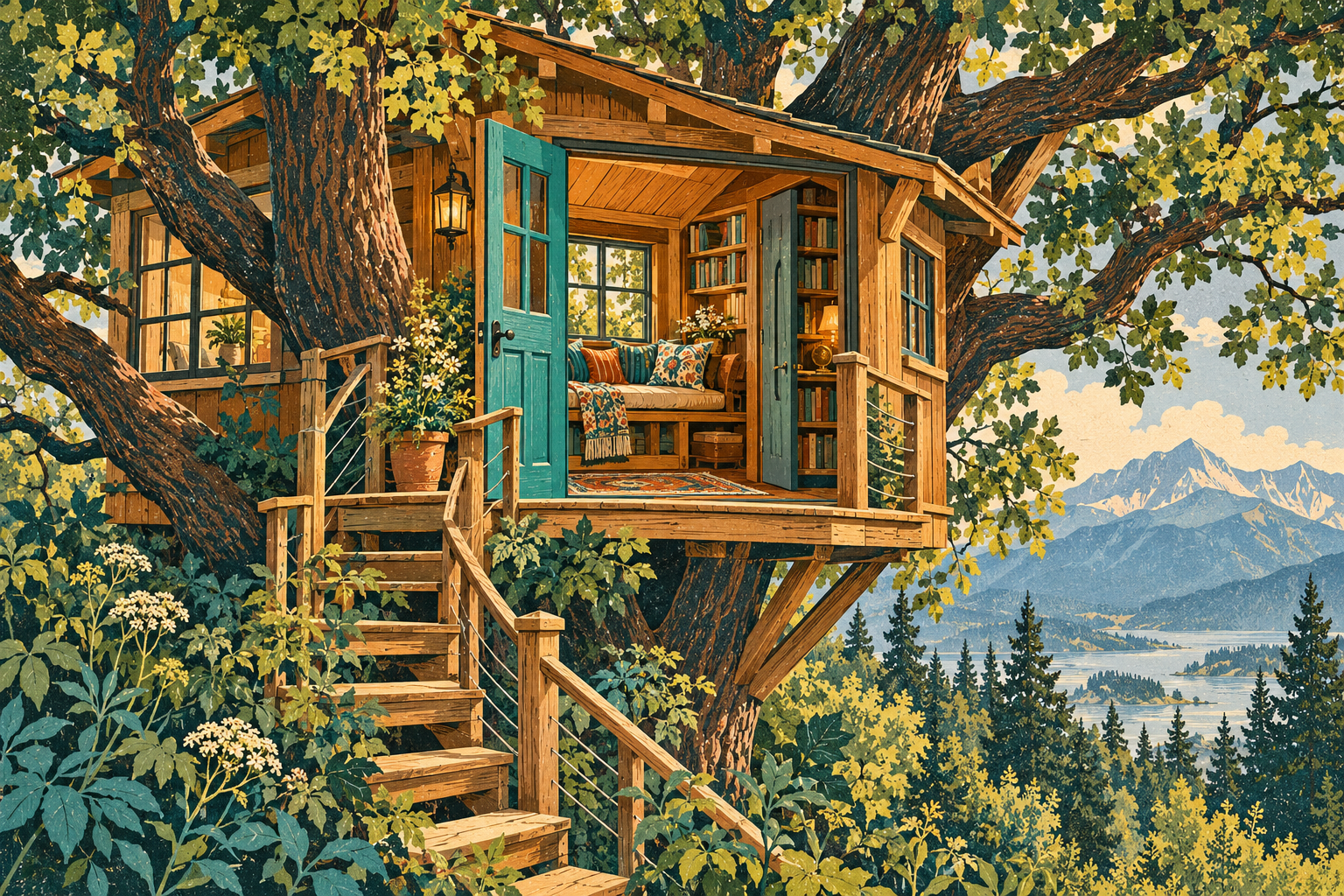
For me, it starts with treehouses: climbing, being among the branches, the whimsy of a room up in a tree. Turquoise. Secret rooms. I have loved all of them since childhood. I guess I have C. S. Lewis and Enid Blyton to thank for this.
I grew up on a smallholding in Somerset, England. My mum rescued battery hens whose featherless, lanky necks still remind me of the chickens in Roald Dahl’s George’s Marvellous Medicine. We had a tortoise, bees, horses, orphan lambs and fish. There was also Blindy, a sheep who could no longer stay with the farmer’s flock after crows had pecked out her eyes.
I’m reading Roald Dahl to my children now, and the books have lost none of their magic. Between the animals and the stories, there is plenty to feed the imagination.
I want trees close by, colour that makes me happy, a little mystery and somewhere to curl up with a book. Rebecca Wakefield’s English country house gives that sense of discovery a physical form: a bookcase opens into a secret den, while the layout makes room for family gatherings and visiting relatives. What interests me is how those pleasures shape the house. You don’t need a country estate to ask where a child might hide with a book, or how a room could make it easier to spend time together. Those questions belong on the floor plan.
When it comes to materials, separating the object from the image that introduced it is a useful start. A tile in a sunlit holiday house comes with flattering company: the architecture, the view, the furniture, perhaps even the suggestion of a less complicated existence. At home, with a sample in my hand, I can pay attention to the tile itself. What do I love about it, and can I imagine enjoying it during the everyday business of living here?
Then I can give it time. For anything expensive or disruptive to undo, I want to live with the sample beside things we already own and return to it after the initial excitement has settled. I also want to be honest about its drawbacks. Would I still choose it, knowing the cost and care it needs, if nobody else ever admired it?
A popular choice can still be personal, and a new discovery can become a lasting love. I want room for artists, colours and objects I haven’t encountered yet. Adding another layer to a room is a different proposition from declaring the whole thing obsolete. A new painting can change its mood without sending perfectly serviceable cupboards to the skip.
If something I design catches on, I don’t need to stop loving it because other people love it too. I see my role as encouraging curiosity and helping people find their own creative voice. I want to share why an idea works so someone can take what interests them and make it their own. That carries a responsibility to create things worth keeping, even after the novelty has worn off.
I will still have to ask where materials come from and what they cost the planet. Affection alone cannot answer those questions. But once I have made a considered choice, I want to give it time to become part of our lives. My house is not a handbag. It can be out of fashion and still be exactly where I want to live.
On the reading table
Jonathan Chapman, Emotionally Durable Design: Objects, Experiences and Empathy.
